

Learn cap table management basics, avoid costly dilution mistakes, and track equity properly. Complete guide with templates, real examples, and tools for founders.
You just closed your first funding round. Congratulations! Now an investor asks, “Can you send over your updated cap table?”
You panic. Is that the same as your equity spreadsheet? Should it include employee options? What about that convertible note from six months ago?
Here’s a sobering stat: 23% of early-stage startups have material errors in their cap tables, according to Carta’s 2024 State of Private Markets report. These errors cost founders an average of 3-7% in unnecessary dilution during their next funding round.
Your cap table isn’t just a spreadsheet—it’s the legal record of who owns what in your company. Mess it up, and you’ll face delayed funding rounds, expensive legal fixes, or worse: investor lawsuits. This guide breaks down everything you need to know about cap table management, from your first founding shares to your Series B and beyond.
What Is a Cap Table and Why It Matters
A capitalization table (cap table) shows who owns your company and how much they own. Think of it as the shareholder registry that answers three critical questions:
- Who has equity in the company?
- What percentage do they own?
- What happens to ownership when new money comes in?
Your cap table tracks every equity transaction: founder shares, employee stock options, SAFE notes, convertible debt, preferred stock from investors, and warrants. It calculates dilution automatically and shows everyone’s ownership on a fully-diluted basis.
Why cap tables matter more than you think:
When Superhuman raised their Series B in 2021, they spent three weeks cleaning up cap table errors from previous rounds before Andreessen Horowitz would close the deal. Those errors? Unconverted SAFEs that weren’t properly recorded, employee options granted but not reflected, and phantom equity from a terminated advisor agreement.
Investors scrutinize cap tables because they reveal:
- How generous you’ve been with equity (or how stingy)
- Whether you have enough shares authorized for future rounds
- If there are any landmines: complex liquidation preferences, participating preferred stock, or messy founder vesting schedules
- Your ability to run a tight operational ship
A clean cap table signals competence. A messy one raises red flags before due diligence even begins.
Key Components of a Cap Table
The Core Elements
1. Common Stock Founder shares and employee equity. Usually split 50/50 or 60/40 between co-founders with four-year vesting and a one-year cliff. Standard vesting protects everyone: if a founder leaves after six months, they don’t walk away with 25% of the company.
2. Preferred Stock Investor shares that come with special rights: liquidation preferences, anti-dilution protection, board seats, and pro-rata rights. Series A investors typically get 1x non-participating liquidation preference, meaning they get their money back first in an exit, then share in the remaining proceeds pro-rata.
3. Options Pool Reserved shares for future employees. Most Series A investors require a 10-15% post-money option pool. If you have 8% pre-money, you’ll need to increase it to 15% post-money, which comes entirely out of founder dilution—not investor dilution.
4. Convertible Instruments SAFEs and convertible notes that haven’t converted yet. These sit as a separate line item with their conversion terms (valuation cap, discount rate) noted. They convert to preferred stock during the next priced round.
5. Warrants Rarely used in early-stage rounds but common in venture debt deals. A warrant gives someone the right to buy shares at a specific price. If you take $2M in debt from Silicon Valley Bank, they might get warrants for 0.5% of the company at your last round’s price.
Understanding Fully-Diluted vs Outstanding Shares
Outstanding shares = shares actually issued and sitting in people’s accounts
Fully-diluted shares = outstanding shares + all options + convertible securities if they converted today
Investors always calculate ownership on a fully-diluted basis. When someone says “I want 20% of the company,” they mean 20% fully-diluted, not 20% of current outstanding shares.
Here’s where founders get confused: You have 1M shares outstanding between you and your co-founder. You create a 200K option pool. Your fully-diluted share count is now 1.2M. An investor wants 20% for $2M. They’re not buying 20% of 1M shares (200K shares). They’re buying 20% fully-diluted, which means:
- Target ownership: 20%
- Your current fully-diluted: 1.2M
- Math: 1.2M / (1 – 0.20) = 1.5M post-money shares
- New shares issued: 300K
- Investor owns: 300K / 1.5M = 20%
You and your co-founder went from 83.3% to 66.7%. The option pool went from 16.7% to 13.3%. Everyone got diluted proportionally except the investor.
Finding the right investors for your stage and sector is crucial. Fundreef provides a searchable database of 10,000+ active VCs, angels, and funds—filtered by geography, check size, and industry focus. Stop sending blind emails and start connecting with investors actually writing checks in your space.
Setting Up Your First Cap Table
Step 1: Incorporate and Issue Founder Shares
Most Delaware C-corps authorize 10M shares at incorporation. Why 10M? It gives you room to issue shares for decades without needing to amend your certificate of incorporation (which requires shareholder approval and costs legal fees).
Your lawyer will help you issue founder shares. Standard split: 5M shares to Founder A, 5M shares to Founder B, all subject to four-year vesting with a one-year cliff.
Pro tip: Use an 83(b) election within 30 days of receiving your shares. This locks in your tax basis at incorporation when shares are worth $0.0001 each. Miss this deadline, and you’ll pay ordinary income tax on the “value” of your shares as they vest—potentially hundreds of thousands of dollars.
Step 2: Create Your Initial Spreadsheet
Start simple. You need six columns:
| Shareholder | Share Class | Shares Owned | % Ownership | Fully-Diluted % | Vesting Status |
|---|---|---|---|---|---|
| Founder A | Common | 5,000,000 | 50% | 50% | 4yr/1yr cliff |
| Founder B | Common | 5,000,000 | 50% | 50% | 4yr/1yr cliff |
| Total | 10,000,000 | 100% | 100% |
Step 3: Add Your Option Pool
Before raising money, create a 10% option pool (1M shares from the 10M authorized). This comes entirely from founder dilution:
| Shareholder | Share Class | Shares Owned | % Ownership | Fully-Diluted % | Vesting Status |
|---|---|---|---|---|---|
| Founder A | Common | 5,000,000 | 50% | 45.45% | 4yr/1yr cliff |
| Founder B | Common | 5,000,000 | 50% | 45.45% | 4yr/1yr cliff |
| Option Pool | Options | 1,000,000 | 0% | 9.09% | Unallocated |
| Total | 11,000,000 | 100% | 100% |
Notice how founders dropped from 50% to 45.45% each? That’s the option pool dilution happening pre-funding.
Step 4: Document Everything
Keep a folder with:
- Stock purchase agreements for each shareholder
- Board consents approving share issuances
- 83(b) election forms (filed with IRS)
- Cap table spreadsheet (updated after every transaction)
- Option grant letters for employees
These documents prove ownership. Without them, you’re fighting over “he said, she said” if disputes arise.
How Funding Rounds Change Your Cap Table
Modeling a SAFE Conversion
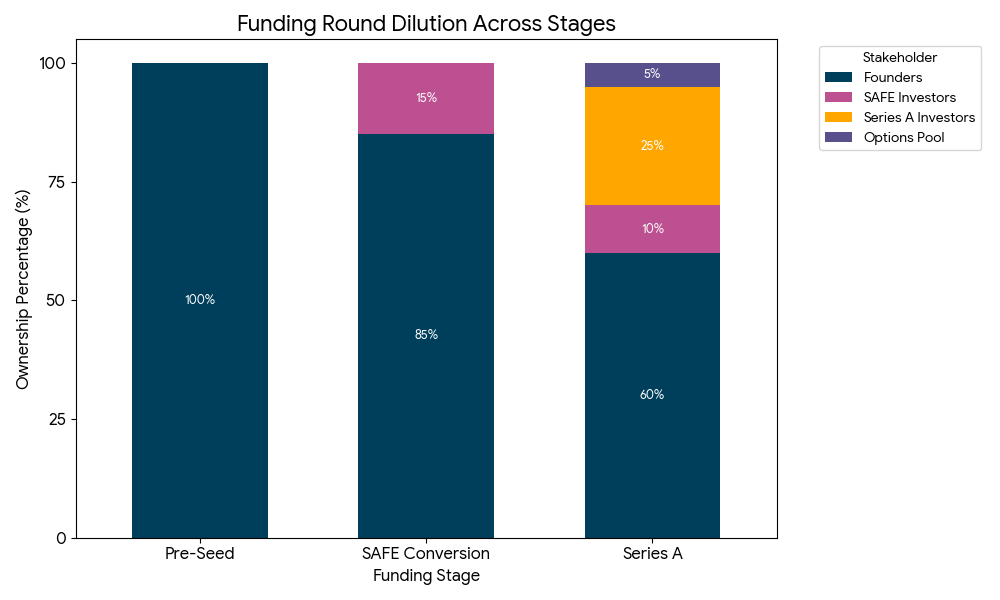
Let’s say you raised $500K on a SAFE with a $5M cap and 20% discount. Six months later, you raise a Series A at $10M pre-money.
The SAFE converts at the lower of:
- Valuation cap: $5M
- Discounted Series A price: $10M × 80% = $8M
Your SAFE converts at $5M (lower number). The investor gets:
- Investment: $500K
- Conversion price: $500K / $5M = 10% of the company
But wait—this is 10% on a pre-money basis, which means post-money ownership will be lower after the Series A dilution.
Full Series A Model
Starting position before Series A:
- Founders: 9M shares (81.8% fully-diluted)
- SAFE investor: converts to ~1.1M shares (10% calculated properly)
- Option pool: 1M shares (9.09%)
- Total: 11M shares
Series A: $3M at $10M pre-money valuation
- Pre-money shares: 11M
- Post-money valuation: $13M
- Price per share: $10M / 11M = $0.91
- New shares for Series A: $3M / $0.91 = 3.3M shares
- Post-money total: 14.3M shares
Final ownership:
| Shareholder | Shares | % Ownership |
|---|---|---|
| Founders | 9,000,000 | 62.9% |
| SAFE Investor | 1,100,000 | 7.7% |
| Series A Investors | 3,300,000 | 23.1% |
| Option Pool | 1,000,000 | 7.0% |
| Total | 14,300,000 | 100% |
Option Pool Increase
Your Series A term sheet says: “15% post-money option pool required.” You currently have 7% post-money. You need to add 8% more shares, which comes from founder dilution before the Series A money comes in.
This is a sneaky dilution tactic. Always negotiate the option pool as part of your valuation discussion.
Common Cap Table Mistakes That Cost Founders Millions
Mistake 1: No Founder Vesting
Jason and Mike start a company 50/50. No vesting. Mike quits after four months. He keeps 50% of the company forever. Jason builds the product, raises funding, and exits for $20M three years later. Mike gets $10M for four months of work.
The fix: Four-year vesting with one-year cliff, no exceptions. Even if you’re best friends. Especially if you’re best friends.
Mistake 2: Verbal Equity Promises
You tell your first engineer, “You’ll get 2% equity.” You never document it. Two years later, they quit and sue for 2% of a company now worth $50M. You have no proof of the terms: vesting schedule, strike price, or even if it was meant to be 2% at that moment or 2% preserved through future rounds.
The fix: Issue formal option grants through your lawyer within 30 days of the promise. Cost: $500-1,000. Cost of lawsuit: $50,000-500,000.
Mistake 3: Ignoring Convertible Note Conversions
You raised three convertible notes over 18 months: $100K, $250K, and $150K, each with different caps and discount rates. Series A closes. Your lawyer asks for conversion calculations. You have no idea.
Result: The notes convert incorrectly, giving investors either too many or too few shares. This gets discovered in Series B due diligence. Your Series B investors demand the cap table be corrected, which means either:
- Diluting someone (they’ll need to approve)
- Buying back shares (expensive)
- Killing the deal (most likely)
The fix: Update your cap table immediately after every transaction, not six months later.
Mistake 4: Using Outstanding Instead of Fully-Diluted
You grant an employee options for “1% of the company.” You calculate this as 1% of outstanding shares. But investors calculate ownership fully-diluted. When your Series A hits, that employee’s 1% becomes 0.6% fully-diluted. They’re upset and leave.
The fix: Always specify fully-diluted ownership in offer letters and calculate using fully-diluted shares.
Real Example: The $12M Mistake
In 2019, a SaaS startup raised a Series B at a $100M valuation. During due diligence, investors discovered the cap table had:
- Unconverted SAFE notes from 2016 that were never recorded
- An advisor who was granted 2% but never signed paperwork
- Employee options granted at the wrong strike price (IRS violation)
The cleanup took three months and cost $200K in legal fees. Worse, the Series B investors reduced their valuation by $12M to account for the risk and sloppiness. The founders lost more in valuation reduction than they would have spent on proper cap table management from day one.
Cap Table Management Tools Compared
You can manage your cap table in three ways: spreadsheets, specialized software, or hire a firm to do it for you.
Spreadsheet (Free – $0)
Best for: Pre-seed companies with <10 shareholders
Pros:
- Free
- Full control
- Easy to understand
- No learning curve
Cons:
- Manual updates prone to errors
- No audit trail
- Doesn’t handle complex scenarios (SAFEs, notes, multi-class stock)
- No 409A integration
- Terrible for scenario modeling
When to graduate: After your first institutional funding round or when you have >15 option holders.
Cap Table Software Comparison
| Tool | Best For | Monthly Cost | Key Features | Limitations |
|---|---|---|---|---|
| Carta | Series A+ startups | $2,000-5,000/yr | Full-service 409A, employee portal, investor relations, scenario modeling | Expensive for early-stage, annual contracts required |
| Pulley | Seed-Series A | $0-600/yr | Affordable, easy interface, good scenario modeling, SAFE/note handling | Fewer integrations than Carta |
| AngelList | Pre-seed/Seed using RUV | Free-$300/yr | Free for basic cap table, integrated with AngelList fundraising | Limited features vs dedicated platforms |
| Capshare | Small startups | $50-200/mo | Simple, affordable, handles basics well | Less sophisticated modeling |
| Ledgy | European startups | €80-500/mo | GDPR compliant, EU-friendly, multiple currency support | Smaller user base, fewer US integrations |
What to Look For
Must-haves:
- SAFE and convertible note modeling
- Scenario modeling (what-if analysis for future rounds)
- Employee stock option management
- 409A valuation integration or support
- Waterfall analysis (who gets what in an exit)
- Audit trail (every change tracked)
Nice-to-haves:
- Employee self-service portal
- Electronic signature for option grants
- Investor dashboard
- Tax form generation (1099s, etc.)
- Multi-currency support for international teams
The Carta Domination
Carta manages cap tables for over 40,000 companies including Notion, Flexport, and Plaid. Their dominance comes from network effects: when your investors, lawyers, and acquirers all use Carta, integration becomes seamless. But you’ll pay for it: $2,400/year minimum, scaling up based on shareholders and transactions.
Is it worth it? If you’re post-Series A with 50+ option holders and complex preferred stock structures, yes. If you’re pre-seed with five SAFEs, probably not yet.
When to Hire a Cap Table Expert
DIY Until This Point
You can self-manage your cap table if you:
- Have fewer than 20 total shareholders
- Haven’t raised institutional VC money yet
- Only have common stock and maybe one SAFE round
- Have a co-founder or employee who’s detail-oriented and comfortable with spreadsheets
Hire Professional Help When
1. You’re raising institutional VC money Series A investors will scrutinize your cap table during due diligence. Errors delay closing or kill deals. Spend $5K-10K to have a lawyer or specialist review and clean up your cap table before going to market.
2. You have complex convertible instruments Multiple SAFEs with different caps and discounts, convertible notes with varying interest rates and maturity dates, or a combination of both creates mathematical complexity. One wrong conversion calculation creates a domino effect of errors.
3. You’re approaching 50+ option holders Managing individual vesting schedules, exercise windows, and strike prices for dozens of employees is error-prone. You need software at minimum, professional help ideally.
4. You’re facing an acquisition Waterfall analysis determines who gets paid what in an exit. With liquidation preferences, participating preferred, and multiple classes of stock, this calculation becomes complex. Get it wrong, and your employees or early investors sue you post-close.
5. You discovered errors from previous rounds Don’t try to fix cap table errors yourself. You’ll likely make them worse. Hire a securities lawyer who specializes in cap tables. Budget $10K-25K for cleanup depending on severity.
Finding the Right Help
Lawyers: Securities lawyers charge $400-800/hour but provide the most thorough cleanup. Use for major errors or pre-acquisition work.
CFO consultants: Fractional CFOs often handle cap table management as part of their services. Cost: $3K-10K/month depending on scope.
Cap table specialists: Firms like trica equity or Abstract Ops focus exclusively on cap table management. Cost: $2K-5K one-time cleanup, $500-1,500/month ongoing.
Your existing lawyer: If you have a startup lawyer, they should review major cap table changes (funding rounds, conversions) as part of their standard engagement. If they don’t, find a new lawyer.
FAQ: Cap Table Management
Q: How often should I update my cap table?
Update your cap table immediately after any equity transaction: funding closes, options are granted or exercised, shares are transferred, or notes convert. Think of it like your bank account—you reconcile it after every transaction, not once a quarter. Waiting creates errors because you’ll forget details or lose documentation.
Q: What’s the difference between pre-money and post-money valuation on my cap table?
Pre-money valuation is what your company is worth before the investment comes in. Post-money is pre-money plus the investment amount. If you raise $2M at an $8M pre-money valuation, your post-money valuation is $10M. The investor owns $2M / $10M = 20% of the company post-money. This matters because ownership percentages are always calculated post-money.
Q: Do SAFE notes appear on the cap table before they convert?
Yes, but as a separate line item showing they’re unconverted. Your cap table should track: investment amount, valuation cap, discount rate, and date issued. When they convert during your priced round, you delete the SAFE line and add the converted preferred shares. Never ignore SAFEs on your cap table—they represent real future dilution.
Q: How do I calculate dilution from a new funding round?
Use this formula: Your new ownership % = (Your current shares) / (Current total shares + New shares issued). If you own 5M shares out of 10M total (50%), and a new investor buys 2.5M shares, your new ownership is 5M / 12.5M = 40%. You’ve been diluted by 10 percentage points (50% → 40%) or 20% relatively (10/50 = 0.20).
Q: What happens to my cap table if a founder leaves?
Depends on your vesting schedule. If they leave before the one-year cliff, they keep zero shares and all shares return to the company. If they leave after one year but before four years, they keep vested shares and unvested shares are returned. If they’re fully vested, they keep everything. The returned shares typically go back to the option pool or are retired, not redistributed to remaining founders.
Q: Should I include advisors on my cap table?
Only if you’re granting them equity. Standard advisor grants are 0.1-0.5% with two-year vesting. Document advisor equity the same way you document employee options: formal grant agreement, vesting schedule, board approval. Never give advisors equity without vesting—they’ll disappear after one phone call and keep the shares forever.
