

Understanding Fundraising Trends in 2025
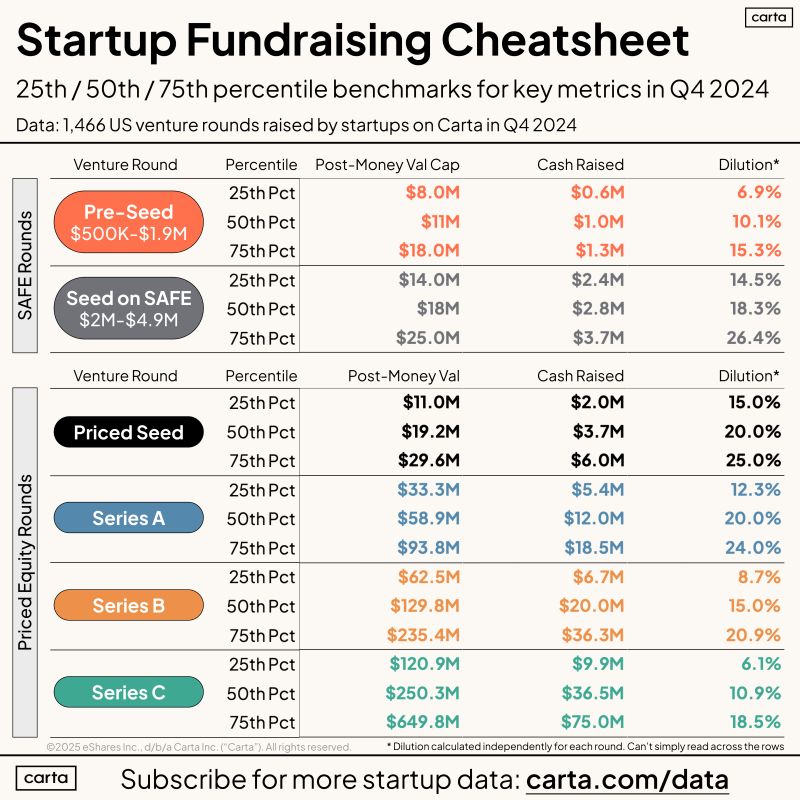
For early-stage founders, securing venture capital is a critical milestone in scaling a startup. Understanding median valuations, cash raised, and dilution at each fundraising stage is essential for optimizing fundraising strategies and negotiating favorable terms. This guide, according to Carta, provides an up-to-date reference for startup founders based on data from 1,466 rounds in Q4 2024 (excluding bridge rounds) in the U.S. tech startup ecosystem.
Key Takeaways:
- Post-money SAFEs were used for Pre-Seed and Seed on SAFE rounds.
- Primary priced rounds were analyzed for Priced Seed, Series A, and Series B.
- Post-money valuation cap was used for SAFE rounds, whereas actual post-money valuation was used for priced rounds.
Fundraising Benchmarks by Stage
Pre-Seed ($500K – $1.9M Raised)
- Median Post-Money Valuation Cap: $10M
- Median Cash Raised: $1M
- Implied Dilution: 10.1% (upon conversion in a priced round)
Pre-seed rounds typically involve friends, family, angel investors, and pre-seed funds. SAFE rounds dominate this stage, offering early backers equity in exchange for capital with minimal governance rights.
Seed on SAFEs ($2M – $4.9M Raised)
- Median Post-Money Valuation Cap: $18M
- Median Cash Raised: $2.8M
- Implied Dilution: 18.3%
Seed rounds on SAFEs are a popular option for early-stage startups, allowing for faster fundraising with fewer legal complexities compared to priced rounds. This funding typically comes from institutional seed funds, accelerators, and larger angel investors.
Priced Seed Round
- Median Post-Money Valuation: $19.2M
- Median Cash Raised: $3.7M
- Dilution: 20.0%
A priced seed round involves formal valuation negotiations and investor rights agreements. Many institutional VCsprefer priced rounds as they provide clarity on valuation, governance rights, and equity stakes.
Series A
- Median Post-Money Valuation: $58.9M
- Median Cash Raised: $12M
- Dilution: 20.0%
At Series A, startups are expected to have strong traction, a scalable business model, and proven market demand. Investors at this stage include top-tier venture capital firms looking for companies with clear growth paths and product-market fit.
Series B
- Median Post-Money Valuation: $129.8M
- Median Cash Raised: $20M
- Dilution: 15.0%
Series B financing supports scaling operations, international expansion, and aggressive market capture. Investors include late-stage VCs and growth equity funds, seeking startups that show substantial revenue growth and strong unit economics.
Interpreting the Data: What Founders Need to Know
While these numbers provide a useful benchmark, every fundraising round is unique and influenced by several factors, including:
1. Sector-Specific Valuation Multiples
- AI startups tend to receive higher valuations due to market hype.
- SaaS companies are often valued based on ARR multiples.
- Consumer startups may have more variance depending on traction.
2. Founder Profile & Market Positioning
- Serial entrepreneurs often raise at higher valuations.
- Competitive positioning within an industry affects deal terms.
3. Investor Appetite & Fund Economics
- Investors balance portfolio diversification and fund size constraints.
- Later-stage rounds are subject to macroeconomic conditions and exit feasibility.
How to Use This Data to Your Advantage
- Set realistic fundraising goals: Understand the typical range of capital raised at each stage.
- Prepare for dilution: Know how much equity founders will likely give up in each round.
- Optimize timing: Raise at a point when valuation and traction justify favorable terms.
- Negotiate strategically: Understand investor expectations to secure the best possible deal.
Final Thoughts
Fundraising in 2025 continues to be highly competitive, with AI-driven companies pushing valuation medians higher. However, fundamentals still matter—investors prioritize strong traction, revenue growth, and solid market positioning.
For founders, this data serves as a baseline to navigate the venture landscape confidently, ensuring strategic decisions that maximize long-term company value.
