

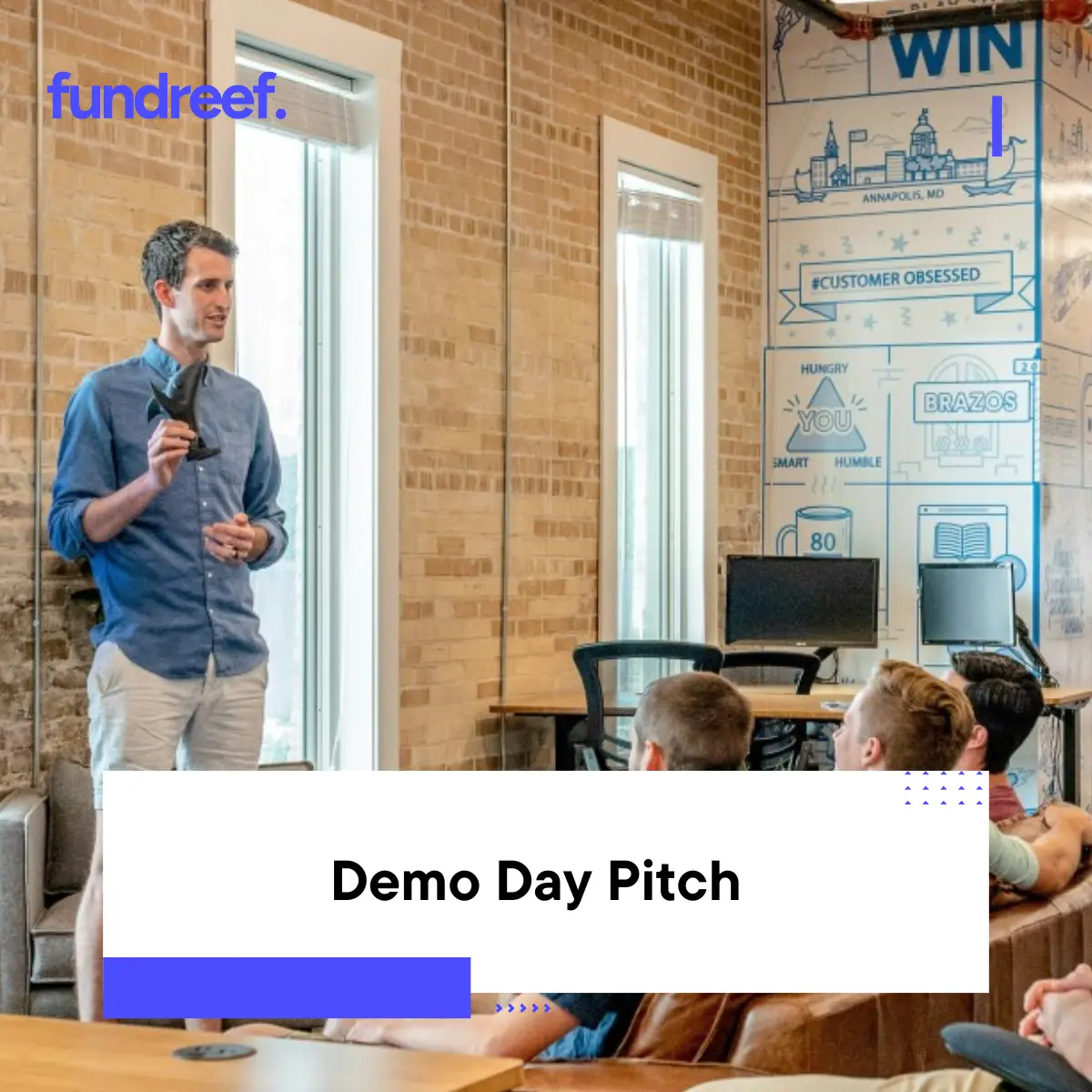
Demo Day pitches convert at 12% to partner meetings vs 3% for cold outreach—but only if you nail 180 seconds. Y Combinator companies face 80+ investors judging 60 startups in 4 hours, meaning you get 3 minutes on stage plus 2 minutes Q&A before next founder. Airbnb’s 2009 Demo Day deck had 10 slides and raised $600K in 2 weeks. This guide breaks down the slide-by-slide formula, delivery pacing (18 seconds per slide), the “hook-proof-ask” structure that books 15 meetings, and Q&A response frameworks for the 5 questions that kill 40% of pitches.
Table of Contents
- Demo Day Format and Constraints
- The 10-Slide Structure
- Slide-by-Slide Breakdown
- Delivery and Pacing
- Body Language and Stage Presence
- Q&A Strategy for 5 Common Questions
- Post-Pitch Follow-Up Sequence
- Frequently Asked Questions About Demo Day Pitches
Demo Day Format and Constraints
Typical Demo Day Setup:
| Element | Specs | Impact |
|---|---|---|
| Time on stage | 3 minutes | 10 slides = 18 sec/slide |
| Q&A time | 2 minutes | 2-3 questions max |
| Audience size | 80-150 investors | Pattern matching, short attention |
| Presentations before you | 20-40 | Fatigue factor |
| Decision window | During/after pitch | Book meetings same day |
What You’re Competing Against:
- 60 other startups pitching same day
- Investor attention span: 90 seconds before tuning out
- Mental scorecard: Problem → Solution → Traction → Team → Ask
Success Metrics:
| Result | Conversion | Good Performance |
|---|---|---|
| Partner meeting requests | 12% avg | 15+ meetings (20%+) |
| Term sheet discussions | 2-3% | 3-5 serious convos |
| Actual investment | 0.5-1% | 2-3 investors close |
YC Demo Day Historical:
- 2009: Airbnb, Stripe presented (3min format)
- 2015: Peak 120 companies/day
- 2024: 60 companies, virtual + in-person hybrid
Constraints Shape Success:
- Can’t tell full story → Focus on wow moment
- Can’t build relationships → Hook them to book meeting
- Can’t answer everything → Anticipate top 3 questions
Model your Demo Day performance with Fundreef’s 3-minute pitch scorer based on 500+ successful presentations.
The 10-Slide Structure
The Winning Formula:
| Slide | Topic | Time | Purpose |
|---|---|---|---|
| 1 | Hook/Tagline | 10 sec | Grab attention |
| 2 | Problem | 20 sec | Create pain |
| 3 | Solution | 25 sec | Show product |
| 4 | Why Now | 15 sec | Market timing |
| 5 | Traction | 30 sec | Proof it works |
| 6 | Business Model | 20 sec | How you make money |
| 7 | Market Size | 15 sec | Addressable opportunity |
| 8 | Competition | 15 sec | Differentiation |
| 9 | Team | 15 sec | Why you’ll win |
| 10 | Ask | 15 sec | Clear call-to-action |
Total: 180 seconds (3 minutes)
What’s Missing (Intentionally):
- Detailed roadmap (too granular)
- Customer testimonials (no time)
- Financial projections (save for diligence)
- Technology deep-dive (investor Q&A)
Structure Purpose:
Hook → Problem → Solution → Proof (Traction) → Opportunity (Market) → Team → Ask
This mirrors investor decision process: “Is this interesting?” → “Is it real?” → “Will it scale?” → “Can they do it?”
Slide-by-Slide Breakdown
Slide 1: Hook (10 Seconds)
Format:
Company name + One-line pitch that surprises
Examples:
Good:
- “Stripe: Payments for developers who hate PayPal” (7 words)
- “Airbnb: Book rooms in people’s homes” (6 words, 2009)
- “Rappi: We deliver anything in 30 minutes” (7 words)
Bad:
- “We’re leveraging AI/ML to disrupt the enterprise SaaS space” (too generic)
- Long company backstory (save for meeting)
Delivery:
Stand center stage, pause 2 seconds, deliver line, advance slide immediately.
Slide 2: Problem (20 Seconds)
Format:
One big problem + one stat that proves it hurts
Structure:
“[Target customer] faces [problem]. [Stat showing scale/pain].”
Examples:
Stripe (2009):
“Developers want to accept payments online. It takes 2 weeks and $10K in legal fees to set up a merchant account. 80% abandon trying.”
Airbnb (2009):
“Hotels charge $300/night in SF. Travelers can’t afford it. Meanwhile, people have empty rooms earning $0.”
Common Mistakes:
- Multiple problems (confusing)
- No data (not credible)
- Problem not painful enough (who cares?)
Slide 3: Solution (25 Seconds)
Format:
Product demo (screenshot or live) + how it solves problem
Structure:
“Here’s [Product]. [Customer] uses it to [key action]. Result: [Outcome].”
Example:
“Here’s our dashboard. Sales teams upload lead lists. Our AI calls 1,000 leads/day, qualifies them, books meetings. Result: 10x more demos booked at 1/5 the cost.”
Visual:
- Actual product screenshot (not mockup)
- Annotate key feature with arrow
- Keep UI simple (they’re 50 feet away)
Delivery:
Point to screen, walk through 1 workflow, show result. 25 seconds max.
Slide 4: Why Now (15 Seconds)
Format:
Market shift that makes this possible now vs 5 years ago
Examples:
Uber (2009): “Smartphones with GPS just launched. Everyone has a tracking device in their pocket.”
Doordash (2013): “60% of restaurants now have websites. They’re ready for online ordering.”
AI Startup (2024): “GPT-4 dropped AI API costs 90%. Voice AI now costs $0.02/call vs $2 in 2022.”
Purpose:
Answers investor question: “Why didn’t Google/Amazon already do this?”
Slide 5: Traction (30 Seconds – MOST IMPORTANT)
Format:
Growth chart + key metric + 1 impressive customer/stat
What to Show:
| Stage | Show This | Example |
|---|---|---|
| Pre-revenue | User growth or waitlist | “10K signups, growing 40%/month” |
| Early revenue | MRR chart | “$50K → $200K MRR in 6 months” |
| Scaling | ARR + logo | “$2M ARR, customers include Amazon” |
Visual:
Hockey stick chart (up and to the right)
Callout: “5x growth in 6 months”
Logo: 1-2 recognizable customers if B2B
Delivery:
“We launched 6 months ago. Here’s our growth: $50K to $200K MRR. Our customers include Amazon and Shopify. Growing 40% month-over-month.”
Pause 2 seconds after saying this (let it sink in).
Slide 6: Business Model (20 Seconds)
Format:
How you make money + unit economics
Structure:
“We charge [customer] $[price] for [value]. CAC: $X, LTV: $Y, ratio Z:1.”
Example:
“We charge sales teams $500/user/month. CAC is $800, LTV is $12K, so 15:1 ratio. Gross margin 85%.”
Keep Simple:
Don’t explain complex revenue streams. Pick primary one.
Slide 7: Market Size (15 Seconds)
Format:
TAM + SAM (skip SOM, too detailed)
Structure:
“[Market vertical] is $XB globally. Our target: $YB segment of [specific customer type].”
Example:
“Sales software is $50B globally. Our target: $8B spent on outbound calling by tech companies.”
Red Flag:
Saying “$1 trillion market”—too broad, not credible. Be specific.
Slide 8: Competition (15 Seconds)
Format:
2×2 positioning chart OR one-line differentiation
Examples:
Chart: X-axis “Price”, Y-axis “Features” → Your bubble in top-right (best value)
One-liner: “Salesforce costs $200/user and takes 6 months to set up. We’re $50/user and 1-day setup.”
Don’t:
Bash competitors (“They suck”) or say “no competitors” (unbelievable).
Slide 9: Team (15 Seconds)
Format:
Founder photos + 1 credential each that matters
Structure:
“I’m [Name], [relevant background]. My co-founder [Name], [relevant background].”
Example:
“I’m Sarah, spent 7 years at Stripe building payment systems. My co-founder Mike ran sales at Dropbox, scaled $0 to $100M.”
What Matters:
Domain expertise > Fancy degrees. “Built same thing at Google” > “MIT PhD” (unless deep tech).
Slide 10: Ask (15 Seconds)
Format:
How much + what for + call-to-action
Structure:
“Raising $[X]M. Using it for [primary use]. Let’s talk.”
Example:
“Raising $2M seed. Hiring 3 engineers and 2 sales reps to scale to $1M ARR. Come find me after—I’m booking meetings now.”
Delivery:
Make eye contact with audience, smile, confident close.
Post-Slide:
Stay on stage for Q&A (2 minutes).
Delivery and Pacing
The 18-Second Rule:
180 seconds / 10 slides = 18 seconds average per slide
Actual Pacing:
- Slides 1-4: Fast (10-20 sec each) = 70 sec
- Slide 5 (Traction): Slow (30 sec) = key proof
- Slides 6-10: Medium (15-20 sec each) = 80 sec
- Total: ~180 seconds
Breathing Technique:
Pause for 1 breath between slides (controls pace, lets audience absorb).
Vocal Delivery:
| Element | Technique | Why |
|---|---|---|
| Volume | 20% louder than conversation | Reach back row, show confidence |
| Speed | 150 words/min (not 200) | Clarity over speed |
| Pauses | After key stats | Let numbers land |
| Emphasis | Traction metrics | “200K MRR” (louder) |
| Energy | 120% of normal | Compensate for stage distance |
Common Mistakes:
- Racing through (nerves) → Practice at 75% speed
- Monotone → Vary pitch on key points
- Reading slides → Memorize, glance only
- Filler words (“um,” “like”) → Pause instead
Practice Regimen:
- 20x run-throughs alone (muscle memory)
- 5x in front of friends (feedback)
- 3x on stage with timer (pressure test)
- Record video, watch, cringe, improve
Body Language and Stage Presence
Positioning:
| Position | When | Purpose |
|---|---|---|
| Center stage | Slides 1, 5, 10 | Command attention |
| Stage left (audience right) | Slides 2-4 | Gesture to screen |
| Center again | Slide 5 (traction) | Emphasize proof |
| Return center | Slide 10 (ask) | Strong close |
Hand Gestures:
Do:
- Open palms (honesty, openness)
- Point to screen for product demo
- Count on fingers (1, 2, 3 points)
- Gesture at chest-waist height
Don’t:
- Hands in pockets (nervous)
- Arms crossed (defensive)
- Fidgeting with clicker
- Pointing at audience (aggressive)
Eye Contact:
Scan zones (divide audience into 5 sections, look at each for 3-5 seconds).
Don’t: Stare at one investor entire time or face screen only.
Facial Expression:
- Smile at Slide 1 (open, friendly)
- Serious at Slide 2 (problem is real)
- Confident at Slide 5 (traction proof)
- Smile again at Slide 10 (excited to talk)
Clothing:
| Audience | Dress Code | Why |
|---|---|---|
| YC Demo Day | Startup casual (jeans + button-down) | Fit in, not distract |
| Techstars | Same | Tech culture |
| Corporate investors | Business casual | Match their formality |
| European VCs | Slightly dressier | Cultural norms |
Energy Level:
In-person: 120% of normal (stage presence)
Virtual: 150% of normal (camera flattens energy)
Use Fundreef’s delivery coach (AI video analysis) to score body language, pacing, and filler word count.
Q&A Strategy for 5 Common Questions
You Have 2 Minutes for Q&A (2-3 Questions Max)
Question 1: “What’s Your CAC?” (40% of Demos)
If You Know:
“$800 CAC, $12K LTV, so 15:1 ratio. Payback in 8 months.”
If You Don’t:
“Still early on unit economics. Current CAC around $1,500, but expect to drop to $500 at scale with [tactic]. Happy to walk through model after.”
Don’t: Make up numbers (they’ll catch you).
Question 2: “How Do You Compete with [Big Co]?” (35%)
Framework:
“[Big Co] serves [broad market]. We focus on [niche]. We’re 10x better at [specific thing] because [reason]. Think of it as [analogy].”
Example:
“Salesforce serves all B2B. We focus only on outbound sales teams under 50 people. We’re 10x faster to set up because we don’t do customization. Think Airtable vs Excel.”
Question 3: “What If They Copy You?” (25%)
Answer:
“Two defenses: [1] Network effects—we have 5,000 customers creating data moat. [2] Execution speed—we’re shipping 2x faster than anyone. Google could copy Dropbox too, but Dropbox still won.”
Don’t: Say “patents” (rarely matter) or “first-mover” (not a moat).
Question 4: “Why Now?” (20%)
Answer:
“Three reasons: [1] [Tech enabler] just got cheap/good, [2] [Customer behavior shift], [3] [Regulatory change]. These converged in last 18 months.”
Example:
“Voice AI got 90% cheaper with GPT-4 APIs. Remote work made companies desperate for sales automation. TCPA regulations now favor AI vs human cold calls.”
Question 5: “How Much Runway?” (15%)
Answer:
“We have [X] months at current burn. This raise gives us [Y] months to hit $[Z] milestone. At that point, we’re break-even or raising Series A.”
Don’t: Say “18 months” if raising seed (seems long, they’ll ask why).
Q&A Dos and Don’ts:
| Do | Don’t |
|---|---|
| Answer in 20-30 seconds | Ramble for 2 minutes |
| “Great question” (buys 2 seconds) | “I don’t know” |
| Redirect to strength | Admit fatal flaw |
| “Let’s discuss after” (complex answer) | Try to explain everything |
Post-Pitch Follow-Up Sequence
Immediately After (30 Minutes):
Investors approach you in hallway. Have ready:
- Business cards (50)
- Calendly link (on your phone)
- Deck PDF (Dropbox link)
Script:
“Great to meet you, [Name]. Here’s my card. Let’s book 30 minutes next week—here’s my calendar [show phone]. I’ll send the full deck tonight.”
Same Day (Within 6 Hours):
Email to Everyone Who Talked to You:
Subject: Great meeting you at Demo Day—[Your Company]
Hi [Name],
Thanks for stopping by our presentation today. As discussed, we’re [1-sentence company description].
Attached:
- Full pitch deck
- Product demo video (2min)
Let’s continue the conversation: [Calendly link]
Looking forward to it,
[Your Name]
Next Day:
Email to investors who DIDN’T approach but you want to meet:
Subject: Following up from Demo Day—[Company]
Hi [Name],
We presented [Company] at Demo Day yesterday ([1-sentence pitch]). Thought it might align with [their thesis/portfolio company].
Quick highlights:
- [Key traction metric]
- [Impressive customer/stat]
- Raising $XM
30min intro call? [Calendly]
[Your Name]
Week 1-2: Meeting Blitz
Goal: Book 15-20 meetings in 2 weeks while momentum hot.
Week 3-4: Term Sheet Push
Follow up with interested investors: “We’re getting close to closing the round. Are you in?”
Conversion Timeline:
- Day 0: Demo Day pitch
- Days 1-3: 10-15 intro meetings booked
- Days 4-14: Meetings happen
- Days 15-21: 3-5 serious investors emerge
- Days 22-30: Term sheets arrive
Track your Demo Day pipeline with Fundreef’s investor CRM showing which VCs opened deck, watched demo, and scheduled calls.
Frequently Asked Questions About Demo Day Pitches
How long should a Demo Day pitch be?
Exactly 3 minutes (180 seconds), 10 slides, 18 seconds average per slide. Slide 5 (traction) gets 30 seconds—most important proof point.
What’s the most important slide in a Demo Day pitch?
Slide 5: Traction. Growth chart showing revenue or users. Investors decide in 30 seconds if you’re “real” or just slides. 30 seconds on this slide, show hockey stick.
How many investor meetings should I get from Demo Day?
15-20 meetings = strong performance (20%+ conversion). 10-15 = solid. Under 10 = weak pitch or market fit issues. Aim for 15+.
Should I memorize my Demo Day pitch?
Yes, word-for-word. Practice 20+ times. Can’t read slides—audience 50 feet away, no notes. Muscle memory only way to deliver confidently in 3 minutes.
What if I run over 3 minutes?
You won’t—they’ll cut you off mid-sentence. Practice with hard timer. Better to finish at 2:50 with strong close than rushed ending at 3:05.
How do I handle Q&A if I don’t know the answer?
“Great question—don’t have exact numbers yet, but here’s directional: [estimate]. Happy to deep-dive after.” Never make up data. Redirect to strength.
