

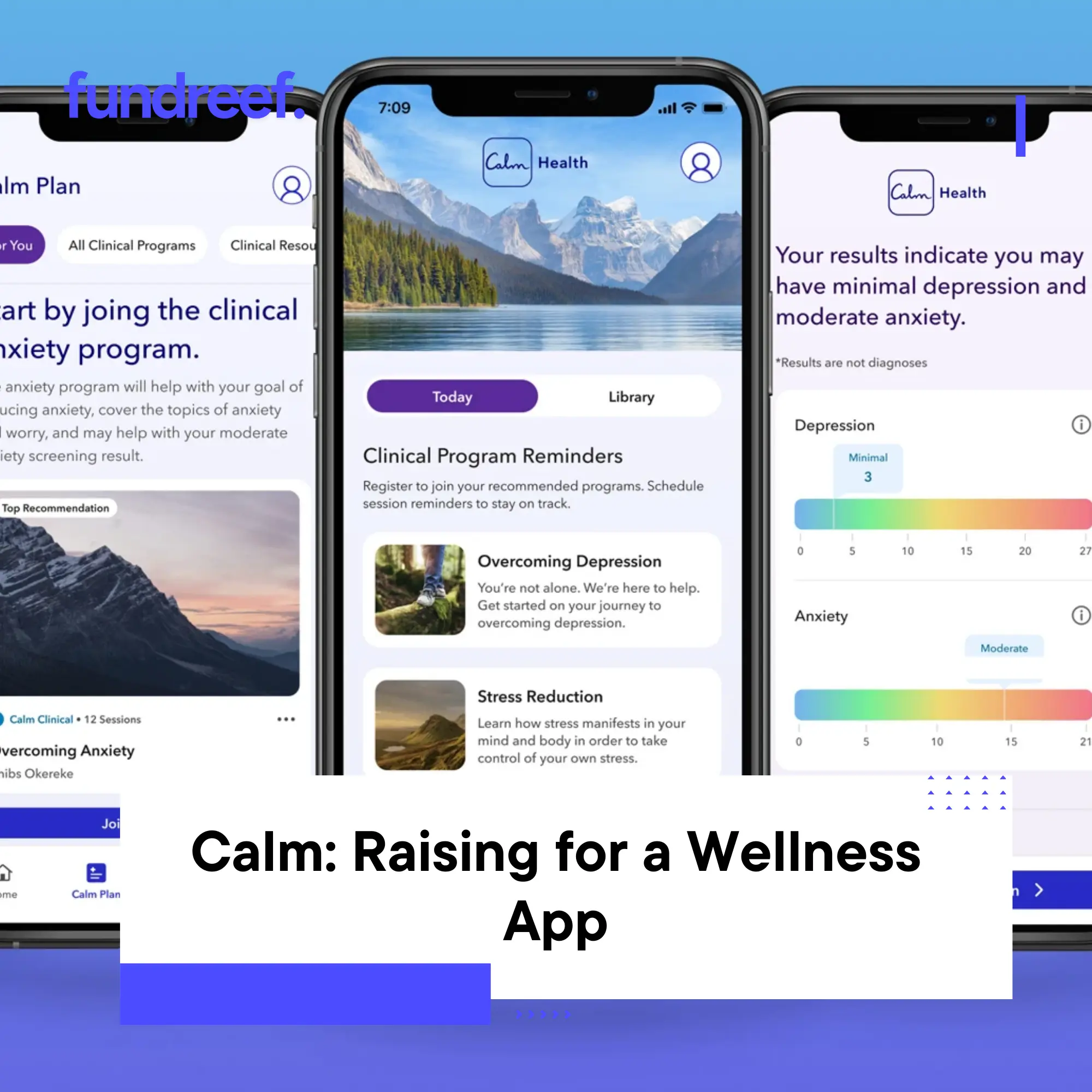
When Alex Tew and Michael Acton Smith pitched Calm to investors in 2014-2017, they faced brutal skepticism: meditation apps were dismissed as “hippie nonsense,” unserious consumer plays that wouldn’t generate revenue, and a niche market too small for venture returns. Headspace had already raised $70M and owned the “meditation app” category—why would VCs bet on a competitor 5 years behind? Early investors passed, forcing Calm to bootstrap with just $1.5M over 5 years while laying off staff five times. But Tew and Smith repositioned: they weren’t a “meditation app”—they were a sleep, relaxation, and mental wellness platform attacking the $4 trillion wellness market and the billion-person sleep deprivation crisis. They proved traction without VC capital: 8 million downloads before spending $1 on ads (organic word-of-mouth), $150M annual revenue run rate by 2018 (freemium conversion working), and differentiation through Sleep Stories (celebrity-narrated bedtime tales for adults—a feature Headspace didn’t have). By 2019, the narrative flipped: Calm raised $88M at $1B valuation (first mental health unicorn), then $75M more at $2B valuation in 2020, proving wellness apps could scale subscription revenue, achieve profitability, and win consumer health category against skepticism.
This guide shows exactly how Calm overcame investor skepticism about wellness apps, the pitch evolution from “meditation” to “sleep and mental health,” how they proved business model viability (freemium, retention, unit economics), why Sleep Stories became competitive moat, funding timeline and key milestones, and lessons for consumer health and wellness founders raising capital.
Table of Contents
- The founding story: from burnout to billion-dollar wellness platform
- Early investor skepticism: why VCs passed on wellness apps
- Calm’s pitch evolution: repositioning from meditation to mental health
- Proving the business model: freemium, retention, and unit economics
- Competitive differentiation: Sleep Stories and celebrity content
- Funding timeline: bootstrapping to unicorn status
- Key lessons for wellness app founders raising capital
- Frequently asked questions about Calm’s fundraising
1. The founding story: from burnout to billion-dollar wellness platform
1.1 The founders’ backgrounds
Michael Acton Smith (Co-founder, Co-CEO):
Previous venture: Founded Mind Candy (2004), creator of Moshi Monsters—an online virtual pet game for kids that reached 80M users and $100M+ revenue.
Burnout experience: After years of intense startup grind (fundraising, scaling, layoffs), Acton Smith experienced severe burnout in 2011-2012. Discovered meditation as recovery tool.
Key insight: “Meditation helped me recover from stress and anxiety. But existing resources (books, classes, retreats) were inaccessible, expensive, or intimidating. There should be a simple app.”
Alex Tew (Co-founder, Co-CEO):
Previous venture: Created The Million Dollar Homepage (2005)—a website that sold 1 million pixels for $1 each as advertising space. Made $1M as college student. Pure internet marketing genius.
Meditation interest: Also practiced meditation, frustrated by lack of modern, accessible tools for beginners.
Key insight: “Meditation has massive TAM (total addressable market)—hundreds of millions of stressed people—but it’s presented as esoteric or religious. We can make it mainstream through great UX and design.”
1.2 The initial vision (2012)
Problem statement:
Stress, anxiety, and sleep deprivation affect 1 billion+ people globally. Existing solutions (therapy, medication, meditation classes) are expensive ($100-200/session), time-intensive, or inaccessible.
Solution:
A simple, beautiful mobile app that makes meditation and relaxation accessible to everyone—for $10/month instead of $200/hour.
Target market:
Stressed professionals, busy parents, insomniacs, anxiety sufferers—anyone seeking mental wellness tools.
Product (2012 launch):
- Guided meditations (7-day beginner series, themed sessions for sleep/anxiety/focus)
- Nature soundscapes (rain, ocean, forest sounds)
- Breathing exercises
- Timed meditation sessions
Business model:
Freemium. Free app with limited content (7 meditations, basic sounds). Premium subscription ($10/month or $60/year) unlocks full library.
Initial launch: Website first (calm.com), then iOS app (2012), Android (2013).
1.3 Early traction (2012–2015): organic growth, zero paid marketing
Key stat: “We got to 8 million downloads before spending a dollar on ads.” —Michael Acton Smith
How they grew without marketing budget:
Beautiful, shareable product:
Calm’s website (calm.com) featured serene nature scene (mountains, lake, ambient sounds) that users would leave open as background. Viral on social media (Twitter, Reddit) as “beautiful, calming website.”
Word-of-mouth:
Users recommended Calm to friends struggling with sleep or anxiety. Organic referrals drove 70%+ of downloads.
App Store optimization:
Calm optimized for “meditation,” “sleep,” “anxiety” keywords. Ranked #1 in Health & Fitness category on iOS (2014).
Press coverage:
Featured in TechCrunch, Wired, NYTimes wellness sections as “meditation app for beginners.”
Daily Calm feature (2015):
Launched daily 10-minute guided meditation (new topic each day, voiced by mindfulness teacher Tamara Levitt). Created habit loop—users returned daily. Retention spiked.
Early metrics (2015):
- 8M downloads
- 100k+ paying subscribers ($60/year average = $6M ARR)
- 4.8/5 star rating on App Store
- Bootstrapped (only $1M raised from angel investors, Jason Calacanis’ LAUNCH accelerator)
2. Early investor skepticism: why VCs passed on wellness apps
2.1 The “meditation apps aren’t venture-scale businesses” narrative
Common VC objections (2014–2017):
“It’s a fad / niche market”
Investors viewed meditation as fringe wellness trend, not mainstream consumer behavior.
Quote from rejections: “Meditation is for yoga enthusiasts and hippies. The TAM is too small for venture returns.”
Reality Calm showed: 40M+ downloads by 2019, 1M+ paying subscribers. Meditation went mainstream.
“Consumer apps don’t have defensibility”
VCs saw Calm as “just an app”—easily copied by competitors or disrupted by YouTube (free guided meditations) or Spotify (sleep playlists).
Quote: “What’s your moat? Anyone can record meditations and put them on an app.”
Calm’s counter: Content quality, brand trust, celebrity partnerships (Sleep Stories with Matthew McConaughey, Harry Styles), and habit formation (users meditate daily, switching cost high).
“Headspace already won the category”
Headspace launched 2010, raised $75M by 2017, had 20M+ downloads. VCs assumed market had clear winner.
Quote: “You’re 5 years behind Headspace. Why would we invest in #2 player?”
Calm’s counter: “We’re not #2. We’re winning on sleep (Sleep Stories differentiate), broader wellness positioning (not just meditation), and faster revenue growth (profitable while Headspace burns capital).”
“Monetization is unproven”
Mental health and wellness historically struggled with willingness to pay (free YouTube meditations, library books, etc.). VCs doubted $10/month subscription would convert.
Quote: “People won’t pay for meditation when YouTube has free guided meditations.”
Calm’s counter: By 2017, 100k+ paying subscribers, $6M+ ARR, 15%+ freemium conversion rate (industry-leading). Proved willingness to pay for premium content and UX.
“Retention will be terrible”
VCs feared users would download app during New Year’s resolution, meditate 3x, then churn.
Quote: “Wellness apps have 90% churn in first month. You’ll never build sustainable business.”
Calm’s counter: Daily Calm feature + Sleep Stories created habit loops. 60-day retention >40% (vs <10% for typical wellness app). Users meditated 2–3x weekly average.
2.2 The Headspace shadow: competing for mindshare
Headspace’s advantages (2012–2017):
Earlier launch (2010 vs 2012):
2-year head start building brand, user base, and investor relationships.
Celebrity founder (Andy Puddicombe):
Former Buddhist monk, credible meditation expert. Appeared on Ellen, Tonight Show.
Massive funding ($75M by 2017):
Could spend on TV ads, partnerships, enterprise deals (B2B2C—selling to companies for employee wellness).
Stronger brand association with “meditation”:
First-mover advantage. When people thought “meditation app,” they thought Headspace.
Calm’s disadvantages:
Underfunded ($1.5M vs $75M):
Could barely afford to hire engineers. Laid off staff 5 times to extend runway.
Perceived as follower:
“Another meditation app” positioning. Investors saw Calm as copycat.
Less press/celebrity:
Headspace had Andy Puddicombe on TV. Calm had no celebrity face early on.
How Calm competed:
Better product (users’ opinion):
Calm had 4.8-star rating vs Headspace 4.6. Users loved UI, voice quality (Tamara Levitt), and Sleep Stories.
Faster revenue growth:
Calm reached profitability 2017. Headspace still burning VC capital.
Broader positioning:
Calm pivoted from “meditation app” to “sleep, relaxation, and mental wellness platform”—bigger TAM than meditation alone.
Acton Smith’s quote: “We always saw ourselves as the Facebook to their Myspace.”
3. Calm’s pitch evolution: repositioning from meditation to mental health
3.1 Early pitch (2013–2016): “Meditation app”
Tagline: “Calm your mind. Change your life.”
Positioning: Guided meditation app for beginners.
Target market: People interested in mindfulness, stress reduction, self-improvement.
Problem with this pitch:
Limited TAM in investors’ eyes. Meditation perceived as niche wellness trend.
3.2 Evolved pitch (2017–2019): “Sleep and mental wellness platform”
Tagline (2017+): “Calm is the #1 app for sleep, meditation, and relaxation.”
Positioning shift:
From “meditation app” to “mental health and sleep solution.”
Key changes:
Lead with sleep, not meditation:
Sleep deprivation affects 70M+ Americans (CDC data), $400B+ economic impact. Sleep is universal problem, not niche like meditation.
Emphasize Sleep Stories:
Unique content (bedtime stories for adults narrated by celebrities). No competitor had this. Became Calm’s signature feature.
Broaden to “mental wellness”:
Stress, anxiety, focus, relaxation—not just meditation. Positioned alongside therapy apps (Talkspace, BetterHelp) but at 1/20th the cost.
Consumer health, not just wellness:
Framed as preventative mental health tool. Partnered with healthcare providers (insurance reimbursement pilots), employers (B2B2C wellness programs).
3.3 The pitch deck evolution (example slides)
2014 pitch deck (meditation focus):
Slide 2 (Problem): “500 million people practice meditation globally, but most lack guidance or access to teachers.”
Slide 3 (Solution): “Calm provides guided meditations for $10/month—1/20th the cost of meditation classes.”
Investor reaction: “Too niche. Meditation is fad.”
2018 pitch deck (sleep and mental health focus):
Slide 2 (Problem): “Sleep deprivation affects 70M Americans, costing $400B annually in lost productivity and health issues. Anxiety disorders affect 40M adults. Existing solutions (medication, therapy) are expensive ($200/session) or have side effects.”
Slide 3 (Solution): “Calm is a mental wellness platform offering sleep tools (Sleep Stories, soundscapes), meditation, and relaxation exercises—helping users sleep better, stress less, and improve mental health for $60/year.”
Slide 6 (Traction): “40M downloads, 1M+ paying subscribers, $150M revenue run rate, profitable. Sleep Stories are our fastest-growing feature—Matthew McConaughey’s story played 8M+ times.”
Investor reaction: “This is huge TAM. Mental health is $200B+ market. Sleep is universal. We’re in.”
Key insight: Repositioning from “meditation” (niche) to “sleep and mental health” (massive TAM) changed investor perception overnight.
4. Proving the business model: freemium, retention, and unit economics
4.1 Freemium model: conversion metrics
How Calm’s freemium works:
Free tier:
- 7-day beginner meditation series (7 Days of Calm)
- Limited Sleep Stories (10 free stories)
- Basic soundscapes (rain, ocean)
- Breathing exercises
Premium tier ($70/year or $15/month):
- 100+ guided meditations (sleep, anxiety, focus, relationships, etc.)
- 500+ Sleep Stories (celebrity narrations, exclusive content)
- Music for relaxation, focus, sleep
- Masterclasses (mindfulness experts, psychologists)
- Offline downloads
Conversion rate (2018 data):
- 15–20% of free users convert to paid within 90 days (industry-leading—typical wellness app <5%)
Why conversion is high:
Low price ($5.80/month if annual):
Cheaper than one therapy session ($200), one yoga class ($25), or coffee habit ($150/month).
High perceived value:
500+ Sleep Stories, 100+ meditations, new content weekly. Users compare to Netflix ($18/month) and find Calm comparable value.
Habit formation:
Daily Calm creates daily usage. Once users meditate 7+ days, conversion spikes (habit established).
Free trial:
7-day free trial of premium. Users experience full library, many convert before trial ends.
4.2 Retention: how Calm keeps subscribers
60-day retention (2018):
~40–50% of subscribers still active after 60 days (vs <10% typical wellness app)
12-month retention:
~25–30% (means average subscriber stays 10–12 months)
Why retention is strong:
Daily Calm (new content daily):
Tamara Levitt’s voice became trusted companion. Users return daily for new meditation. Habit loop = retention.
Sleep Stories (nightly use):
Users listen to Sleep Story every night to fall asleep. Becomes essential sleep ritual. Churn = insomnia returns.
Content variety:
100+ meditations means users don’t exhaust library. Always something new (stress, anxiety, relationships, focus).
Offline downloads:
Users download meditations for flights, commutes, travel. Works without internet = higher usage.
Sunk cost:
After 30 days of daily meditation, users don’t want to “break the streak.” Streaks incentivize retention.
4.3 Unit economics: LTV vs CAC
Customer Acquisition Cost (CAC, 2018):
Organic (70% of users): $0 (word-of-mouth, App Store search)
Paid (30% of users): $10–$20 (Facebook/Instagram ads, influencer partnerships)
Blended CAC: ~$5–$7 per user
Lifetime Value (LTV):
Average subscription length: 10–12 months
Annual price: $70/year
LTV: ~$60 (accounting for churn, discounts)
LTV:CAC ratio: 10:1 (exceptional—most SaaS targets 3:1)
Gross margin: 85%+ (digital product, low COGS—just content production and cloud hosting)
Why unit economics are strong:
Low CAC (organic growth dominates):
Word-of-mouth, App Store optimization, press coverage = free customer acquisition.
High LTV (retention + low churn):
Daily usage habits (Daily Calm, Sleep Stories) create sticky product. Subscribers stay 10+ months.
Scalable margin:
Content production is fixed cost. Adding 1M more subscribers doesn’t increase content costs proportionally (network effects).
Investor takeaway: Calm has SaaS-like unit economics (high LTV:CAC, 85% margin, scalable) in consumer health category—rare combination that justified $1B+ valuation.
5. Competitive differentiation: Sleep Stories and celebrity content
5.1 Sleep Stories: Calm’s “secret weapon”
What are Sleep Stories?
Bedtime stories for adults—25–45 minute narrations designed to help listeners fall asleep. Mix of soothing voice, gentle narrative, ambient sound design (rain, forest, crackling fire).
Topics: Fictional tales (train journeys through Scottish Highlands, walking through lavender fields), non-fiction (history of sleep, astronomy), travel guides (scenic routes), nostalgia (childhood memories).
Launch: 2016 (4 years after Calm founded)
Why Sleep Stories became competitive moat:
No competitor had this:
Headspace focused on meditation. Other apps (Relax Melodies, Pzizz) had soundscapes but not narrative storytelling.
Unique use case:
Meditation requires focus/attention. Sleep Stories require passive listening. Easier for beginners (no “am I doing this right?” anxiety).
Celebrity narrations:
High-profile voices made Sleep Stories shareable, press-worthy, differentiated.
Virality:
Users shared “I fell asleep to Matthew McConaughey’s voice” on social media → free marketing.
Retention driver:
Users listened nightly (vs meditating 2–3x weekly). Higher frequency = stronger retention.
5.2 Celebrity partnerships that changed the game
Matthew McConaughey (2018):
Narrated “Wonder,” a Sleep Story about childhood imagination. Became Calm’s most popular content—10M+ plays within months.
Impact: Media coverage (NYTimes, CNN, Ellen featured it), viral social media, celebrity credibility, subscriber spike (20% MoM growth following launch).
Harry Styles (2020):
Narrated “Dream With Me,” a Sleep Story released during COVID-19 pandemic lockdowns (anxiety/insomnia spiked).
Impact: Trended on Twitter, 5M+ plays in first week, younger demographic (Gen Z) discovered Calm.
LeBron James (2020):
Partnered for “Train Your Mind” mental fitness content (not Sleep Story, but meditation/mindfulness for athletes).
Impact: Expanded Calm’s appeal to sports/performance audience.
Stephen Fry, Idris Elba, Laura Dern, others:
A-list celebrities lending voices to Sleep Stories created premium brand perception.
Why celebrities partnered with Calm:
Mental health destigmatization:
Celebrities wanted to support mental wellness, reduce stigma around therapy/meditation.
Personal use:
Many celebrities used Calm themselves (LeBron, Harry Styles publicly mentioned using app).
Creative project:
Narrating Sleep Story was low-effort, high-impact creative contribution (1–2 hour recording session).
Alignment with brand:
Calm’s mission (mental wellness) aligned with celebrities’ values (social impact, self-care).
Investor takeaway: Sleep Stories + celebrity content created brand moat that competitors couldn’t replicate (Headspace tried bedtime content 2019 but lacked celebrity firepower).
6. Funding timeline: bootstrapping to unicorn status
6.1 Seed funding (2013–2014): $1M total
June 2013: $465k seed round (angel investors)
June 2014: $578k seed round (Jason Calacanis’ LAUNCH accelerator)
Total seed: ~$1M
Traction at seed:
1M+ downloads, freemium model launched, $500k ARR (estimated)
Challenge:
Headspace raised $30M Series A (2015). Calm still bootstrapping with $1M total.
Acton Smith’s quote: “We laid off staff five times to extend runway. It was brutal, but we stayed alive.”
6.2 Series A (June 2018): $27M at $250M valuation
Lead investor: Insight Partners (enterprise SaaS-focused VC)
Traction at Series A:
- 40M downloads
- 1M+ paying subscribers
- $150M annual revenue run rate
- Profitable (rare for consumer apps)
Use of funds:
- Hire engineers (scale product, reduce bugs)
- Content production (more Sleep Stories, meditations)
- International expansion (localize content for non-English markets)
Why investors said yes:
Proven business model:
$150M revenue, profitable, strong unit economics (LTV:CAC 10:1).
Category leadership:
Calm surpassed Headspace in revenue, downloads, App Store ranking.
Sleep positioning:
Broader TAM than meditation. Sleep = universal problem.
Retention + engagement:
Daily usage (Daily Calm, Sleep Stories) created habit, reducing churn.
6.3 Series B (February 2019): $88M at $1B valuation (unicorn)
Lead investor: TPG Growth (growth equity firm)
Participating investors: Insight Partners, CAA (Creative Artists Agency), Sound Ventures (Ashton Kutcher’s fund)
Traction at Series B:
- 50M+ downloads
- 2M+ paying subscribers
- $200M+ ARR
- Quadrupled revenue in 2018 (100%+ YoY growth)
Valuation: $1B (first mental health unicorn)
Use of funds:
- International expansion (localize for Europe, Asia)
- B2B2C (enterprise wellness partnerships—sell Calm subscriptions to companies for employees)
- Content (celebrity Sleep Stories, masterclasses)
- Marketing (first paid ad spend—TV, digital, influencer partnerships)
Why investors valued at $1B:
$200M+ ARR at 85% margin = $170M gross profit
TAM expansion:
Mental health market = $200B+ (therapy, medication, wellness apps). Sleep market = $70B+ (sleep aids, mattresses, devices). Calm positioned to capture share.
Competitive moat:
Sleep Stories, celebrity content, brand trust, retention.
Path to $1B+ revenue:
If Calm maintained 100% YoY growth, $1B ARR achievable by 2021–2022.
6.4 Series C (December 2020): $75M at $2B valuation
Lead investor: Lightspeed Venture Partners
Traction at Series C:
- 100M+ downloads
- 4M+ paying subscribers (COVID-19 pandemic drove mental health app adoption)
- $300M+ ARR
COVID-19 impact:
Massive user growth:
Lockdowns, anxiety, insomnia → Calm downloads spiked 200%+ (March–May 2020).
Subscriber surge:
Free trials converted at higher rates (people desperate for sleep/anxiety relief).
Press coverage:
Media covered mental health crisis, featured Calm as solution.
Use of funds:
- Global expansion (100+ countries, 30+ languages)
- Partnerships (healthcare providers, insurance companies exploring reimbursement for Calm subscriptions)
- Product expansion (Calm Business for employers, Calm Health for clinical populations)
Valuation rationale:
$2B valuation = 6.7x revenue multiple ($300M ARR). Justified by: retention, profitability, global TAM, and potential for clinical/insurance partnerships.
6.5 Funding summary table
| Round | Date | Amount | Valuation | Lead Investor | ARR at Time |
|---|---|---|---|---|---|
| Seed | 2013–2014 | $1M | — | LAUNCH | $500k |
| Series A | June 2018 | $27M | $250M | Insight Partners | $150M |
| Series B | Feb 2019 | $88M | $1B | TPG Growth | $200M |
| Series B extension | July 2019 | $27M | — | Lightspeed | — |
| Series C | Dec 2020 | $75M | $2B | Lightspeed | $300M+ |
| Total | 2013–2020 | $218M+ | $2B | — | — |
Key insight: Calm went from $1M seed (2014) to $2B valuation (2020) in 6 years—100,000% increase in valuation.
7. Key lessons for wellness app founders raising capital
7.1 Lesson #1: Reposition from niche to universal problem
Calm’s mistake (early pitch): “We’re a meditation app.”
Investor reaction: “Meditation is niche wellness trend. Too small TAM.”
Calm’s fix: “We’re a sleep and mental health platform. Sleep deprivation affects 70M Americans. Anxiety affects 40M. Mental health is $200B market.”
Investor reaction: “That’s venture-scale. We’re interested.”
Takeaway: Frame wellness app around universal, urgent problem (sleep, stress, anxiety, chronic pain) not wellness trend (meditation, yoga, journaling).
7.2 Lesson #2: Prove monetization before scaling
Calm’s approach: Bootstrapped with $1M for 5 years, reached $150M ARR before raising Series A.
Why this worked: Proved freemium model, retention, and unit economics. Investors saw $150M revenue + profitability = de-risked investment.
Contrast: Many wellness apps raise seed, scale users to 10M+, then struggle to monetize. Calm proved willingness to pay first.
Takeaway: Consumer apps (especially wellness) face “will users pay?” skepticism. Prove it with revenue before raising big rounds.
7.3 Lesson #3: Build habit loops, not one-time usage
Calm’s retention drivers:
Daily Calm: New meditation every day → users return daily
Sleep Stories: Nightly listening ritual → users rely on Calm to fall asleep
Streaks: Track consecutive days → users don’t want to break streak
Result: 40–50% 60-day retention (vs <10% typical wellness app)
Takeaway: Wellness apps succeed when they become habits (daily/weekly use), not sporadic (downloaded, used 3x, forgotten). Design for frequency.
7.4 Lesson #4: Differentiate with unique content, not just UX
Calm’s differentiation: Sleep Stories (no competitor had this), celebrity content (Matthew McConaughey, Harry Styles), Tamara Levitt’s voice (beloved by users).
Why it mattered: Prevented commoditization. Headspace had meditations, but Calm had Sleep Stories. Users couldn’t get that elsewhere.
Takeaway: Wellness apps risk commoditization (meditation/yoga content widely available). Differentiate with proprietary content, talent, or format.
7.5 Lesson #5: Use organic growth to prove product-market fit
Calm’s growth (2012–2017): 40M downloads, $150M ARR with $0 spent on ads.
How: Beautiful product, word-of-mouth, App Store optimization, press coverage.
Investor signal: “If they grew to $150M revenue organically, imagine what happens when we pour $50M into marketing.”
Takeaway: Organic growth (especially in consumer apps) proves product-market fit better than paid growth. Investors value companies that grow without capital.
7.6 Lesson #6: Compete on business model, not features
Calm vs Headspace (2017):
Headspace: $75M raised, burning $20M+/year, not profitable, focused on meditation only.
Calm: $1M raised, profitable, $150M revenue, broader positioning (sleep + mental health).
Calm’s pitch: “We’re capital-efficient, profitable, and growing faster than Headspace despite 1/75th the funding.”
Investor reaction: “Calm has better unit economics and execution. We’ll fund them instead.”
Takeaway: If competitor raised more capital, compete on efficiency, profitability, and capital discipline. VCs value path to profitability over capital consumption.
Frequently asked questions about Calm’s fundraising
How did Calm overcome investor skepticism about meditation apps?
Calm repositioned from “meditation app” to “sleep and mental health platform,” emphasizing universal problems (70M Americans with sleep deprivation, 40M with anxiety, $200B mental health market) instead of niche wellness trend. They proved business model viability with $150M revenue run rate, profitability, 15–20% freemium conversion rate, and 40–50% 60-day retention before raising Series A—eliminating “will users pay?” concerns.
Why did Calm raise only $1M while Headspace raised $75M early on?
Calm couldn’t convince VCs to invest 2014–2017 due to “meditation is niche” skepticism and Headspace’s first-mover advantage (investors assumed category had one winner). Founders bootstrapped, laying off staff five times to extend runway. This forced capital discipline, leading to profitability by 2017—which became competitive advantage when raising Series A (investors valued profitability over Headspace’s capital burn).
What role did Sleep Stories play in Calm’s fundraising success?
Sleep Stories became Calm’s competitive moat and differentiation from Headspace. Celebrity narrations (Matthew McConaughey, Harry Styles) generated viral press coverage, social media buzz, and subscriber growth (20% MoM spike after McConaughey launch). Investors saw unique content that competitors couldn’t replicate, nightly usage (stronger retention than meditation), and broader TAM (sleep vs meditation). Sleep Stories proved in Series A/B pitches.
How did Calm prove strong unit economics to investors?
Calm showed LTV:CAC ratio of 10:1 (exceptional vs 3:1 SaaS benchmark): $5–7 blended CAC (70% organic growth, 30% paid ads at $10–20 CAC) and $60 LTV (10–12 month average subscription at $70/year). 85%+ gross margin (digital product, low COGS), 15–20% freemium conversion rate, and 40–50% 60-day retention proved sustainable, scalable business model.
What traction did Calm have at each funding round?
Seed (2014): 1M downloads, $500k ARR. Series A (2018): 40M downloads, 1M paying subscribers, $150M ARR, profitable. Series B (2019): 50M downloads, 2M subscribers, $200M ARR, 100% YoY growth, $1B valuation (first mental health unicorn). Series C (2020): 100M downloads, 4M subscribers, $300M+ ARR, $2B valuation (COVID-19 pandemic drove mental health app adoption surge).
What lessons can wellness app founders learn from Calm’s fundraising journey?
Reposition from niche wellness trend to universal problem (sleep/anxiety vs meditation), prove monetization before scaling (revenue + profitability de-risks investment), build habit loops for retention (daily/nightly usage, not sporadic), differentiate with unique content (Sleep Stories, celebrity partnerships), use organic growth to prove PMF ($0 ad spend → $150M ARR signals product-market fit), and compete on capital efficiency vs competitors (profitability vs capital burn).
Suggested visuals to create
- Calm’s pitch evolution diagram
Two-column comparison: Left (2014 pitch): “Meditation app for mindfulness” → TAM: Meditation market $5B → Investor reaction: “Too niche.” Right (2018 pitch): “Sleep & mental health platform” → TAM: Sleep $70B + Mental health $200B → Investor reaction: “Venture-scale.” Show how repositioning changed narrative. - Funding timeline with traction milestones
Horizontal timeline 2013–2020: Seed $1M (2014, 1M downloads), Series A $27M (2018, 40M downloads, $150M ARR), Series B $88M (2019, $1B valuation, first mental health unicorn), Series C $75M (2020, $2B valuation, 100M downloads). Show ARR growth curve accelerating. - Unit economics breakdown
Visual flowchart: User downloads free app → 15–20% convert to paid ($70/year) → Stays 10–12 months (LTV $60) → Acquisition cost $5–7 (70% organic) → LTV:CAC = 10:1 → 85% gross margin → Profitability. Show why Calm’s economics justified $1B+ valuation.
