

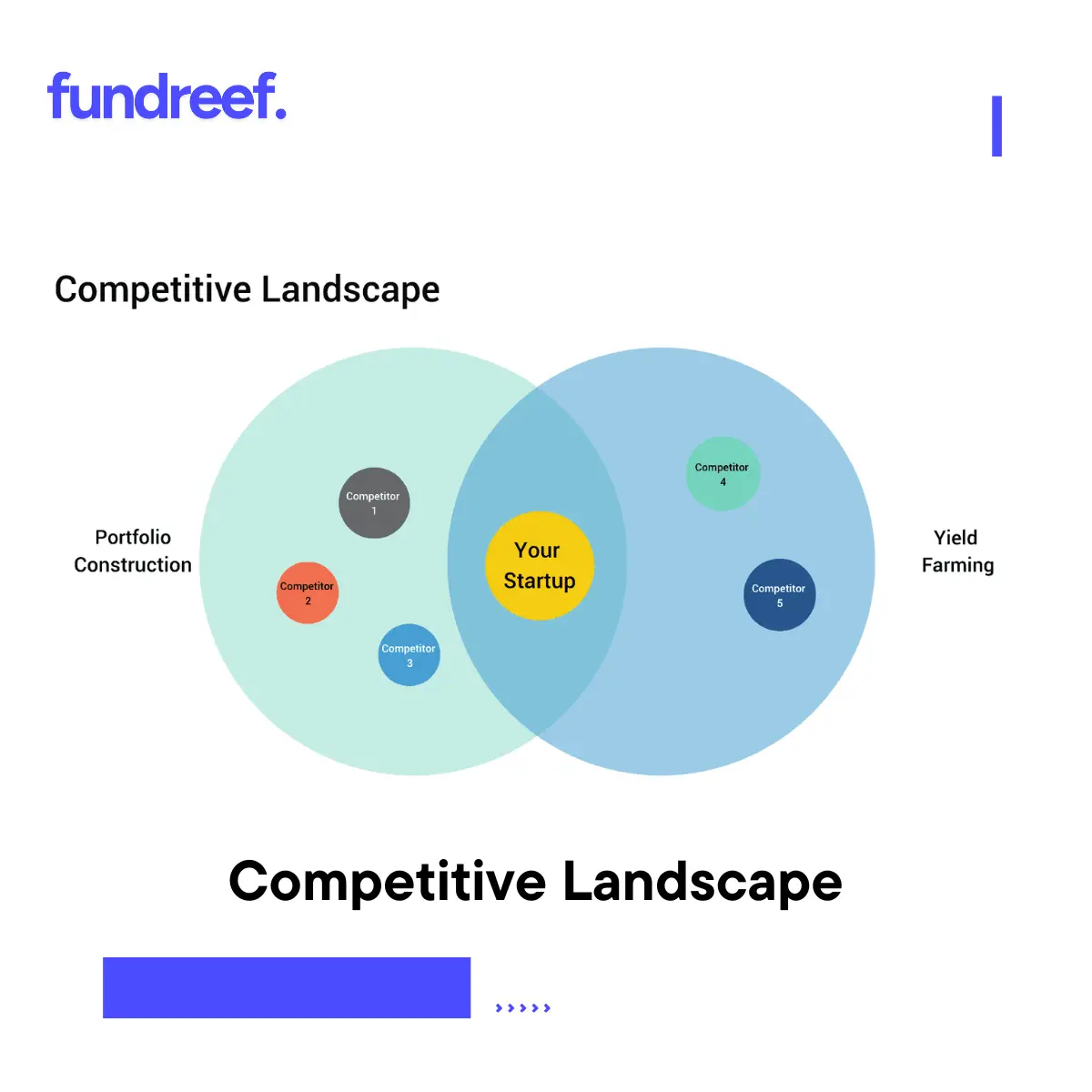
Your Series A investor asks: “Who’s your main competitor?” You answer: “No one. We’re the first to do X.” The investor slides your deck aside. “Next.”
This is the moment every founder dreads. Investors don’t believe “no competition” claims—they’ve heard them 500 times. What they want is proof you understand your market deeply: who customers currently use, why they switch, how you’ll win, and where you’ll build defensible moats.
Competition slides done right don’t scare investors—they build confidence. A great competitive landscape shows: (1) you know the battlefield, (2) you’ve mapped customer alternatives, (3) you understand switching dynamics, and (4) you have a clear wedge to dominate.
Poor slides kill deals. Great slides unlock them. This guide breaks down how to build competitive positioning that turns “Who else does this?” from a threat into your strongest advantage.
Table of Contents
- Why Investors Obsess Over Competition
- The Three Types of Competitors You Must Map
- Building Your Competitive Matrix (The Right Way)
- The 4×4 Positioning Framework
- Finding Your Wedge: Where Incumbents Are Vulnerable
- Customer Switching Dynamics: Why They Actually Change
- Pricing Wars: How to Position Without Competing on Price
- Feature Gaps vs Integration Moats
- Messaging: “Better Than” vs “Different From”
- When Competition Is Actually Good News
- Common Competitive Slide Mistakes
- Frequently Asked Questions About Competitive Positioning
Why Investors Obsess Over Competition
Investors aren’t testing your product knowledge—they’re testing your market understanding. “No competition” signals naivety. “Everyone is a competitor” signals paranoia. Both destroy credibility.
Investors want to know:
- Market reality: Customers currently spend money somewhere. Who gets it?
- Switching costs: How hard is it to move customers to your solution?
- Defensibility: What stops copycats once you prove the model?
- Growth potential: Is there €1B+ TAM or just a €50M niche?
Your competitive slide answers: “I get it. Here’s the full landscape. Here’s why we win.”
The Three Types of Competitors You Must Map
Most founders only list direct competitors. That’s table stakes. Map all three layers.
Layer 1: Direct Competitors (Solving Same Problem, Same Customers)
| Competitor | Founded | Revenue | Funding | Strengths | Weaknesses |
|---|---|---|---|---|---|
| Company A | 2018 | €50M ARR | €120M | Brand, sales team | Slow innovation |
| Company B | 2020 | €15M ARR | €40M | Price leader | Poor support |
| Company C | 2019 | €8M ARR | Bootstrapped | Feature depth | No enterprise |
Layer 2: Indirect Competitors (Alternative Solutions)
| Solution Type | Examples | Why Customers Choose | Your Advantage |
|---|---|---|---|
| Manual processes | Excel, consultants | No switching cost | Automation saves 80% time |
| Legacy software | SAP, Oracle | Entrenched | Modern UX, API-first |
| Internal builds | Custom tools | Full control | Scalable, secure |
Layer 3: Future Competitors (Who Will Enter)
| Potential Entrant | Why They’ll Try | Why They Won’t Succeed |
|---|---|---|
| Big Tech (Salesforce) | €10B ARR opportunity | Can’t move fast, wrong UX |
| New startups | Viral YC demo | No enterprise sales experience |
| Incumbents (ServiceNow) | Defend territory | Technical debt, slow iteration |
Pro tip: Future competitors show sophistication. “Salesforce will try this but fail because…” demonstrates you understand barriers to entry.
Building Your Competitive Matrix (The Right Way)
The classic “us vs them” feature matrix is dead. Investors ignore 20-column spreadsheets comparing 47 features. They want category positioning.
The Right Matrix: Value Proposition vs Customer Segment
| SMB (€0-10M ARR) | Mid-Market (€10-100M) | Enterprise (€100M+) | |
|---|---|---|---|
| Your Company | Self-serve, €99/mo | Sales-assisted, €5K/mo | Full-service, custom |
| Competitor A | Self-serve only | Weak | Terrible |
| Competitor B | SMB-focused | Self-serve only | No |
| Legacy | Manual | Manual | Consultants (€50K/mo) |
This shows category leadership across segments, not feature parity.
Feature Matrix (Only When Necessary)
If features matter, focus on 3 decision criteria:
| Speed | Integration | Price | |
|---|---|---|---|
| You | Real-time | 200+ APIs | €99-€5K |
| Competitor A | 24hr batch | Salesforce only | €250/mo |
| Competitor B | Real-time | Zapier only | €49/mo |
| Legacy | Weekly | None | €50K/yr |
Never do 10×10 grids. Investors glaze over.
The 4×4 Positioning Framework
Positioning isn’t “better features.” It’s category creation + customer segmentation.
Step 1: Define Your Category
Don’t say “CRM software.” Say:
- “AI sales copilot” (Gong)
- “Headless CMS” (Contentful)
- “Modern data stack” (dbt)
Your category should be:
- Specific enough to own (not “SaaS”)
- Broad enough to scale (€1B+ TAM)
- New enough to claim (not “ERP”)
Step 2: Map Customer Segments
| Segment | Pain Point | Budget | Decision Maker | Your Fit |
|---|---|---|---|---|
| Segment A | Problem X | €10K/yr | VP Marketing | Perfect |
| Segment B | Problem Y | €50K/yr | CRO | Strong |
| Segment C | Problem Z | €200K/yr | CEO/CTO | Later |
Step 3: Position Against Each Segment
SMB: “Fastest path to value. Self-serve in 5 minutes.”
Mid-market: “Scales with your team. Unlimited support.”
Enterprise: “Mission-critical reliability. 99.99% uptime.”
One product, three messages.
Step 4: Own the 2×2 Matrix
| Speed | Scale | |
|---|---|---|
| Easy | You | Competitor B |
| Hard | Competitor A | Legacy |
You’re “Easy + Fast.” Others cluster in slow/complex corners.
Finding Your Wedge: Where Incumbents Are Vulnerable
Incumbents lose to startups at inflection points. Find theirs.
Speed Wedge
Incumbents: Quarterly releases, 18-month roadmaps
You: Weekly updates, customer-driven iteration
Example: “Notion vs Evernote.” Evernote shipped annually. Notion shipped weekly.
Integration Wedge
Incumbents: Closed ecosystems
You: Open platform, 200+ native integrations
Example: “Airtable vs Excel.” Excel can’t connect to Stripe, Slack, Salesforce.
UX Wedge
Incumbents: 1990s enterprise UX
You: Consumer-grade, mobile-first
Example: “Figma vs Photoshop.” Photoshop = pro tools, bad UX. Figma = pro tools, great UX.
Distribution Wedge
Incumbents: 6-month sales cycles
You: Viral, product-led growth
Example: “Calendly vs Chili Piper.” Chili Piper needs sales reps. Calendly spreads organically.
Pro tip: Your wedge expands over time. Speed wedge → UX wedge → distribution wedge → platform wedge.
Customer Switching Dynamics: Why They Actually Change
Investors want to know acquisition isn’t just “cold emails + big budget.” Map switching psychology.
| Current Solution | Trigger to Switch | Your Hook |
|---|---|---|
| Manual (Excel) | Hiring 5th team member | “Automate in 1 day” |
| Competitor A | Feature parity | “Same features, 5x faster” |
| Legacy (SAP) | New CTO | “Modern alternative” |
| Internal tool | Scaling past 50 users | “Enterprise-grade security” |
Quantify switching costs:
- Time to migrate: 2 weeks vs 6 months
- Data export: CSV vs locked-in
- Training: 2 hours vs 2 weeks
Low switching = fast acquisition. High switching = sales motion required.
Pricing Wars: How to Position Without Competing on Price
Never compete on price alone. Position as premium or value leader.
Premium Positioning (€ High)
| Brand | Price | Positioning | Target |
|---|---|---|---|
| You | €299/mo | Best-in-class | Wants excellence |
| Competitor | €149/mo | Good enough | Price-sensitive |
Messaging: “The #1 platform trusted by [Stripe, Shopify].”
Value Positioning (€ Low)
| Brand | Price | Positioning | Target |
|---|---|---|---|
| You | €49/mo | Most complete | Needs everything |
| Competitor | €99/mo | Premium features | Feature buyers |
Messaging: “All the power of [competitor] at half the price.”
Avoid: Middle positioning. Be #1 or different.
Feature Gaps vs Integration Moats
Features get copied. Integrations create lock-in.
| Feature Type | Competitor Copy Time | Your Defense |
|---|---|---|
| UI tweaks | 1 month | Iterate faster |
| New algorithms | 3-6 months | Data moats |
| Integrations | 6-12 months | Platform lock-in |
Integration moat examples:
- HubSpot + 1,000 apps = ecosystem lock-in
- Shopify + 8,000 apps = merchant dependency
- Slack + 2,500 apps = team stickiness
Build 10+ deep integrations first. Features second.
Messaging: “Better Than” vs “Different From”
Wrong: “10x faster than Competitor X”
Right: “The only [category] built for [segment]”
Examples:
- “The only design tool that works like Google Docs” (Figma)
- “The only CRM without a sales team” (Pipedrive)
- “The only database that scales like AWS” (PlanetScale)
Different > Better. Investors remember positioning, not benchmarks.
When crafting your competitive positioning and identifying the specific customer segments where you have structural advantages, comprehensive market analysis becomes essential to validate your wedge hypotheses. Fundreef’s AI business plan generator helps you structure your competitive analysis into a clear narrative that shows investors exactly why your positioning creates durable market leadership.
When Competition Is Actually Good News
Heavy competition validates market demand. No competition signals unclear problem/solution fit.
Healthy competitive signals:
- Multiple funded startups in adjacent spaces
- Incumbents acquiring smaller players
- Enterprise RFPs mentioning your category
- €1B+ VC money flowing into the vertical
- Competitors with 10x your traction
- Winner-take-all dynamics (1 dominant player)
- Declining market spend signals
Competition proves you’re not early—you’re right on time.
Common Competitive Slide Mistakes
Mistake 1: “No Competition”
| Wrong | Right |
|---|---|
| “No direct competitors” | “Customers currently use Excel + consultants” |
Mistake 2: Feature Checklists
| Wrong (10 columns) | Right (3 criteria) |
|---|---|
| 47 features compared | Speed, Integration, Price |
Mistake 3: Ignoring Indirects
| Wrong | Right |
|---|---|
| Only 3 direct competitors | Direct + indirect + future |
Mistake 4: Generic Claims
| Wrong | Right |
|---|---|
| “10x faster” | “Self-serve in 5 minutes vs 5 weeks” |
Mistake 5: No Customer Focus
| Wrong | Right |
|---|---|
| Competitor logos | Customer segments + pain points |
Frequently Asked Questions About Competitive Positioning
How many competitors should I show?
5-8 total: 2-3 direct, 2-3 indirect, 1-2 future threats. More than 10 overwhelms. Less than 5 looks naive.
What if my competitor has better funding/traction?
Acknowledge it. “Company X raised €50M and has €10M ARR. They target enterprises. We’re targeting mid-market with self-serve.” Show whitespace.
Should I name-drop Big Tech competitors?
Yes, if relevant. “Salesforce owns 60% enterprise CRM. We target SMBs they ignore.” Big Tech validates market size.
How do I position against open source?
“Open source = free, zero support. We = free trial, 24/7 enterprise support.” Paid beats free when switching costs are high.
What if customers say “we’re happy with current solution”?
Dig deeper: “What specifically do you love? What frustrates you?” Map gaps quantitatively. “85% want faster onboarding” → your wedge.
How often should I update competitive positioning?
Quarterly. Incumbents ship new features. New entrants emerge. Customer needs evolve. Static positioning = outdated strategy.
