

Learn how to calculate TAM, SAM, and SOM for your investor pitch. Understand the key differences, how to apply these metrics, and why they matter when raising capital for your startup.
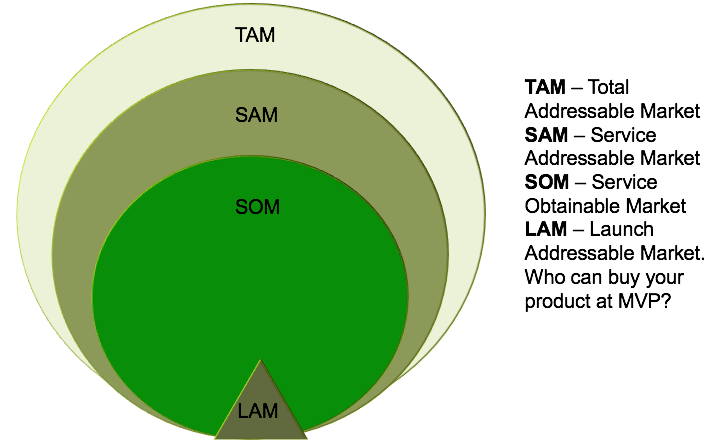
When you’re preparing to pitch your startup to investors, one of the key components they want to understand is your market opportunity. Specifically, investors will be looking for clear metrics like TAM, SAM, and SOM. These three critical components—Total Addressable Market (TAM), Serviceable Available Market (SAM), and Serviceable Obtainable Market (SOM)—are essential in determining the scale of opportunity your startup can address.
In this article, we’ll walk you through how to calculate TAM, SAM, and SOM for an investor pitch, why these figures matter, and how to use them to tell a compelling story to investors. Whether you’re just starting or preparing for your next fundraising round, understanding these metrics is key to gaining investor confidence.
What Are TAM, SAM, and SOM?
Before we dive into the calculation process, let’s first understand what each of these metrics means:
1. TAM (Total Addressable Market)
TAM represents the total revenue opportunity available if your product or service achieved 100% market share. It defines the largest potential market size for your business. Think of TAM as the theoretical maximum of what your startup could achieve if there were no competitors.
For example, if you’re selling a new type of software, TAM would include every business or individual in the world that could potentially use your software.
2. SAM (Serviceable Available Market)
SAM is the portion of the TAM that your product or service can address based on your business model, geographic location, and other limiting factors. Essentially, it’s the subset of your TAM that fits your current offering and capabilities.
For instance, if your software is designed for small to medium-sized businesses in North America, your SAM would only include the businesses in this region that fit that profile.
3. SOM (Serviceable Obtainable Market)
SOM is the segment of the SAM that you can realistically capture in the short to medium term, based on factors like competition, your marketing strategy, and sales efforts. It’s the most refined and realistic portion of the market that your startup can actually target and convert into paying customers.
Think of SOM as the slice of the pie you can go after right now, considering your resources and competitive landscape.
How to Calculate TAM, SAM, and SOM for Investor Pitch
Now that we understand the definitions, let’s talk about how to calculate these metrics in a way that investors will find valuable. Here’s a step-by-step guide to help you through the process.
Step 1: Calculate TAM (Total Addressable Market)
To calculate TAM, you’ll need to figure out the total revenue your startup could potentially generate if it captured 100% of the market. You can calculate TAM using a top-down or bottom-up approach:
- Top-down approach: Start with industry-wide data and work your way down. For example, you might start with the total global market for software solutions and then narrow it down to your specific product type.
- Bottom-up approach: Start with your unit economics (price per product) and multiply it by the potential number of customers. This approach can be more realistic since it’s based on actual potential sales.
Example Calculation:
- Global market for small business software = $100 billion
- Your product addresses 5% of that market = $5 billion TAM
Step 2: Calculate SAM (Serviceable Available Market)
Now that you have your TAM, you need to focus on the market that is realistically accessible to your startup. To calculate SAM, consider the following factors:
- Geographic scope: Is your product available only in specific regions or globally?
- Target customer segment: What portion of your TAM does your startup’s product actually serve?
- Regulatory restrictions: Are there any legal constraints or other limitations?
Example Calculation:
- If your product targets small businesses in North America, and North American businesses represent 30% of the global market for small business software, your SAM would be $5 billion * 30% = $1.5 billion.
Step 3: Calculate SOM (Serviceable Obtainable Market)
SOM is where things get more granular. To calculate SOM, think about the portion of your SAM that you can realistically capture over the next 1-3 years, based on your resources, sales efforts, and market conditions.
Factors to consider:
- Current sales: If you have existing customers, you can base your SOM on your conversion rate and sales pipeline.
- Marketing budget: How much can you spend on marketing and how effective will it be?
- Competitive landscape: What portion of the market are competitors currently serving, and how much can you capture?
Example Calculation:
- If you plan to capture 10% of your $1.5 billion SAM over the next 3 years, your SOM would be $1.5 billion * 10% = $150 million.
Why Investors Care About TAM, SAM, and SOM
Now that you understand how to calculate these metrics, it’s important to know why investors care about them so much. These metrics help investors assess several critical factors:
1. Market Potential
Investors want to understand how large your market is. TAM gives them the full picture of opportunity, while SAM and SOM demonstrate how much of that opportunity you can realistically capture. A high TAM indicates that there is significant potential, but SAM and SOM provide the grounded, achievable projections that investors need.
2. Scalability
By breaking down the market into SAM and SOM, you show how your startup can scale over time. This helps investors gauge whether your business model can grow rapidly and reach a significant portion of the market.
3. Product-Market Fit
Calculating SAM and SOM also helps demonstrate that your product has a clear market fit. Investors want to see that you’re targeting a well-defined, reachable audience rather than trying to serve everyone.
How to Present TAM, SAM, and SOM in Your Investor Pitch
Now that you’ve calculated TAM, SAM, and SOM, it’s time to present these metrics in a way that’s compelling to investors. Here are some tips for doing just that:
- Be visual: Use graphs and charts to clearly show the difference between TAM, SAM, and SOM. Investors are often visual thinkers, so a well-designed chart will make the data easier to digest.
- Focus on SOM: While TAM is impressive, investors care most about your SOM—the slice of the market you can realistically capture in the near term. Make sure to explain how your strategy will allow you to target and convert that portion of the market.
- Back up your numbers: Provide data and research that supports your calculations. Investors are more likely to believe your projections if you show them how you arrived at these numbers.
FAQs About TAM, SAM, SOM for Investor Pitch
1. Can TAM, SAM, and SOM be calculated for any industry?
Yes! TAM, SAM, and SOM can be applied to nearly any industry. Whether you’re in tech, health, consumer goods, or any other field, you can use these metrics to define the market potential for your startup.
2. What if I don’t have enough data to calculate TAM?
If you lack hard data, you can use industry reports, third-party research, and comparable companies to estimate your TAM. While it’s ideal to use actual data, investors often accept well-reasoned estimates in early-stage pitches.
3. How do I make sure my SOM is realistic?
To make sure your SOM is realistic, focus on your sales strategy, customer acquisition costs, and market dynamics. Look at competitors and your current pipeline to refine your SOM estimate.
Conclusion: How to Calculate TAM, SAM, SOM for Investor Pitch
Calculating TAM, SAM, and SOM is an essential part of preparing for an investor pitch. These metrics not only demonstrate the market opportunity but also showcase the scalability and realistic growth potential of your startup. By breaking down these figures, you can create a data-driven, compelling case for your business and attract the right investors.
If you’re looking for the perfect investor match for your startup, consider leveraging an AI-powered investor database for startups. Connecting with the right investors can help you take your business to the next level.
